Sunday, August 14, 2016

Two suspects in Thailand’s blasts | New Mandala

Two suspects in Thailand’s blasts | New Mandala
Zachary Abuza, 13 AUG, 2016


The latest bombings and arson attacks in Thailand are most likely to be the actions of Malay insurgents or radical Red Shirts, writes Zachary Abuza. 
Between 10 and 12 August, Thailand was rocked by a string of 14 IED attacks across eight provinces in its upper south.
Four people were killed and 33 wounded, including 10 Western tourists. Authorities defused two of the 14 improvised explosive devices (IEDs) placed at the tourist destination on 10 August, but never made this public until after the other bombings. Police also found one other suspicious object, but have not commented on whether it was an IED. To date no one or group has claimed responsibility.
In addition, there were five separate suspicious fires — possibly arson attacks in Phang Nga, Krabi, Trang, Surat Thani and Nakorn Sri Thamarat that destroyed markets, a Tesco Lotus, and other buildings. Police are investigating whether these were straight up arsons or caused by incendiary IEDs, that are frequently seen in the south. All of these arsons occurred between 02:15 and 08:00 and intended to minimise casualties.
Many of the IEDs were “double tap”, going off in quick succession. And yet the casualty rate was relatively low. Four IEDs caused no casualties.

The IEDs were relatively small. Almost all were detonated by cell phones. While they are similar to IEDs found in Thailand’s Deep South, where an insurgency has been ongoing since 2004, that says nothing. There are only so many ways to make an IED, and the bomb-making plans are readily available online.
The five locales for the IEDs were tourist areas. But the size, design and placement of the devices was clearly not intended to maximise casualties. They were designed to send a message.
The question is from whom? There are plenty of suspects. There is no evidence that this was an external terrorist group, such as ISIS or even Uighur extremists responsible for the August 2015 Erawan Shrine bombing in Bangkok.
This was domestically orchestrated, which leaves two suspects: Malay insurgents or radical red shirts or other regime opponents. Both have their motives to discredit the military regime at this time.
Suspect one: Malay insurgentsThe insurgency is now in its 13th year, and has reached a stalemate. Peace talks with the military are going absolutely no where. The goal of the Thai army is clearly to degrade the insurgency and get violence to a low enough level that they can attribute it to criminality, and thus have no need to make any meaningful concessions at the negotiating table.
Violence in 2016 is clearly down, as it was in 2015. The average monthly death toll is currently just under 13, a third of what it was in 2009. Since the start of 2009, the monthly average number of casualties in the south has been 81. But since the May 2014 coup, it has fallen to 49.

It’s been years since the insurgents have been able to pull off large-scale coordinated attacks across multiple cities and provinces, and even when they have, its always been confined to the three-and-a-half provinces of the Deep South: Narathiwat, Yala, Pattani and parts of Songkhla. Out of area attacks such as Koh Samui in 2015 have been one-off attacks.
They do like to hit tourist venues, but they have been “out of area” while remaining “in area”. They hit tourist venues for Malaysians, such as Sungai Golok, Betong, Hat Yai, and Sadao, where there are few if any Westerners. These are all on the periphery of their claimed territory. And even attacks in these places have been quite limited. Insurgents are clearly aware that a major attack on a tourist venue would ultimately be counterproductive.
Technically the Malay insurgents have the capacity to do these attacks. Insurgents routinely use double tap IEDs, though in a more sophisticate away to target first responders. Insurgents, likewise, have never claimed responsibility for any attacks. The question is if they have the logistic ability to pull it off. While I have my doubts, it is worth noting that the extensive network of checkpoints in the Deep South could actually make out of area attacks easier to perpetrate.
I should note that much of the evidence regarding the bombings in Sadao, Betong, Hat Yai and Koh Samui suggest that these were carried out by hardline cells frustrated at either the pace and scope of the insurgency or the peace process itself.
The April 2015 Koh Samui bombing was clearly intended to send a signal, not kill people. The junta tried to false flag the attack on Red Shirts, and it was not until June 2015 that charges were actually filed against insurgents.
And with the peace talks stalled and the new charter that completely precludes any type of regional autonomy, there is plenty of reason to suspect some insurgents have decided that it is time to escalate the violence to get the junta’s attention. They have an incentive to remind the junta the costs to not negotiating.
The Deep South was one of only three regions that overwhelmingly rejected the charter in the referendum, in addition to the Red Shirt bastions in Issarn and the North. There is clearly antipathy for any continued military hold on power and their current policies towards the Malay region. Don’t forget that in the days before and of the referendum, there were 35 IEDs across the Deep South, a time of heightened security.
The junta blamed the fact that 60 per cent of the voters in the Deep South rejected the charter on the fact that they were “intimidated and pressured by the insurgency group.” The government was clueless that the charter gives no hope for devolution of power and autonomy, while pushing Buddhist nationalism on a community fighting for its identity.
If the attacks were perpetrated by the insurgents it would be both unprecedented and suggest a sharp shift in their strategy.
Suspect two: radical Red ShirtsThere is also plenty of reason to suspect radical political opponents of the military regime. That the bombings occurred on the eve and day of the Queen’s birthday, a national holiday, seems designed to discredit the military, who have justified most everything they have done — as self serving as it usually is — in the name of defending the monarchy.
The military’s continued hold on power is, in their own words, necessary to maintain peace and security. Clearly the scope of bombings discredits them. It reiterates the concern that security forces are so focused on peaceful protestors and activists against the junta, that they have dropped the ball on thwarting bonafide security threats.
The location of the attacks is interesting for another reason. The upper south region voted in very high margins in the 7 August referendum for the draft charter that will perpetuate military rule indefinitely.
With the restrictions on campaigning against the referendum, including up to 10-year jail terms, restricting open discussion and coercing voters, the referendum was truly shambolic. And many radicals opposed to the military see no alternatives but extralegal means to challenge the military.
And that could explain the choice of targets. All the bombing locales were in tourist destinations. Yet, none of the bombs was really meant to kill a lot of people. Even the physical damage they did was limited, according to these photos. They were intended to do harm to the tourist economy.
The junta has convinced itself that its rule is legitimate following the referendum. That is something I would challenge, seeing that they only won 61 per cent of 55 per cent of the electorate who bothered to turn up — that is, only 34 per cent of possible votes. Most independent analysts see the charter as having done little to reconcile the country’s deep divisions.
But the junta remains very vulnerable in terms of their stewardship of the economy. Foreign direct investment plummeted last year and exports are anemic. The Wall Street Journal politely described the economy as “underperforming.”
Tourism accounts for 10 per cent of the economy and is a critical cash cow. Even among their core supporters, the junta’s economic management has been their achilles’ heel. The referendum has done little to convince the business community or international investors that it will be smooth sailing ahead.
So who did it?I really don’t know. I could argue it either way as both groups have a clear motive. Thai authorities claim that they have two people in custody, linked to the first two defused IEDs in Phuket. But they have provided no additional information as yet.
It is important that we brace for another politically motivated and incompetent investigation, as we happened following the Erawan Shrine bombing, when a shocking number of leads went un-investigated. To this day, there are far more questions about that devastating attack than answers.
The junta is likely to follow suit this time around. As a junta spokesman said, “This is not a terrorist attack. It is just local sabotage that is restricted to limited areas and provinces.”
But the attacks do discredit the regime whose legitimacy is far shakier than they care to admit.
The junta seemed awfully smug after the referendum. These attacks are a reminder of how divisive the military really is, and how far they really need to go to address the deep cleavages with both political opponents of the regime, and ethnic Malay.
And while I am not sure who perpetrated the attacks, I am certain of one thing: the junta will likely double down in its divisive and self-serving policies, rather than address legitimate and core grievances of large sectors of society.
Zachary Abuza is a professor at the National War College where he focuses on Southeast Asian politics and security.




Decades of dominance and a junta’s demise | New Mandala

Decades of dominance and a junta’s demise | New Mandala
Dr James L Taylor, 11 AUG, 2016


Thailand’s referendum has installed the military junta for the long haul. But could it also be their undoing? 
The result is out; it is back to 1978.
No surprises. Now the junta can gloat over its inevitable, foregone conquest and lecture the Western world about minding its own business, which they were quick to do after the win.
As one Thai person told me: “Well, maybe Thais now have the democracy they deserve!”
The suppression of free speech and critical debate around the referendum are well known, even begrudgingly among normally ‘yellow’ influenced Bangkok-based journalists.
It was clear that Thais were not given the details about the draft constitution, except those parts deemed suitable for public propaganda, and critiques of the draft were forbidden. Massive more-unpalatable sections of the translated version were left out.
If those sycophantic voters for the military’s constitution had no idea of the implication of their “yes” vote, in the not-too-distant-future they may soon think twice .
But the masses were never given the truth and many people continued to believe in the military-elite’s feel-good iron-fist nationalism. It all reminds me a little of a less tame version of Brexit.
That aside, more seriously, information from regional sources such as the Asian Network for Free Elections (ANFREL) indicates that the numbers were stacked at some crucial ballot centres, there were many more ballots that actual registered voters.
In one Bangkok district, for instance, there were 298 people coming to vote on the day and 335 ballots. There were no witnesses allowed at the ballot stations when the counting was carried out. (For a good summary see Prachatai).
It was reported (unofficially) that there were many more ballots that actual registered voters. In one Bangkok district for instance there were 298 people coming to vote on the day but 335 ballots counted. There were no witnesses allowed at the ballot stations when the counting was carried out.
It also appears that the kingdom was clearly divided along ancient divisions, with “Lanchang” (and the Northeast Region generally), Lanna (North) and Pattani, voting “no”, while the mid-southern (the PDRC stronghold) and central region voting “yes”.
But all may be not lost, despite the prospect of decades of dominant and repressive military rule ahead, and little chance of being able to amend the constitution – with the charter enshrining military ineffective coalition “governments”, unelected prime ministers, appointed senates, and so on.
At least this is the view of some red shirt leaders, such as exiled founder of the Organisation of Free Thai Network, Jakrapob Penkair (7 August 2016). He noted that the result was inevitable, “knowing the nature” of the amaat regime. But, he also outlined a few reasons for some optimism among all the gloom saying that the consequence of the new constitution will show to the world the true nature of the military-royal alliance and power.
The result will also encourage the pro-democracy (red) activists to reconcile as they have split into two primary factions over the past decade or so: the electoral faction and the revolutionary faction. While the electoral faction wanted elections quickly, the so-called revolutionary side ridiculed them (“revolutionary” in the sense of rhetoric not action).
Both sides he noted now need each other to establish a unified ideology and action, so as to bring power to the democracy movement. He said that the revolutionary faction did not understand the constraints that the previous elected governments were under, in the gaze of the amaat regime. These elected governments since 2005 had to work on the surface within the established legal framework. They had no real power to make lasting progressive changes being blocked at every turn.
Jakrapob noted that the situation now will enable a unified and systematic approach to bringing about democracy, liberty and rights in the coming decades.  But do not hold your breath — it will be a long-term project.
Meanwhile, the evidence has been mounting about massive military corruption since the last coup, despite attempts to silence critics. The military junta takes a page from boxing, where the best form of defence is attack.
In regard to the politicised notion of getting rid of “kong” (cheating) or corruption, Jakrapob said let the military regime continue with their propaganda until the “san phra phum” eventually falls (literally “spirit house”, but an illusion to monarchy).
When we reach that time the truth will shock the nation from trivial matters such as which subordinates under “higher ups” are selling the soil of Parliament House at 300 Baht per square metre(a budget was allocated to build a new Parliament House), to bigger matters — including who owns the PTT Public Company Limited? Who benefits? Who is the real owner of Temasek Holdings?
Who is behind stopping the construction of the Kra Isthmus Canal (an economic opportunity always stopped)? And who is behind extensive real estate interests, taking land from the people which makes it hard to undertake effective land reform?
These are the people who are actually cheating the nation and yet no one dares to challenge this. Therefore, it is good that the military’s constitution puts “kong” in the charter, so that one day we can use this to expose the nation’s real cheats.
This is similar to the great Ayutthaya poet Sri Prat who said that the owner of the sword will eventually kill themselves with their own weapon. This time we are defeated in the game, but not in the battle with the regime (rabob).
But now that Thailand has now slipped back in time one thing is clear — this generation and possibly the next will have to continue the struggle for democracy.
Dr James L Taylor is Adjunct Associate Professor, Anthropology & Development Studies, University of Adelaide.


A vicious cycle of coups and constitutions | New Mandala

David Camroux, 06 AUG, 2016


Thailand has been searching for an appropriate form of government for more than 80 years. It’s unlikely to find one this Sunday when the country votes on a contentious new constitution.
At first glance, there may be something unique in the Thai military junta seeking to have its action and program legitimised through approval by referendum of a somewhat undemocratic constitution. Yet, in other ways — from a long-, medium- and short-term perspective — this is in continuity with the political trajectory of modern Thailand since the end of the absolute monarchy in 1932.
Thailand’s second military coup in 1932 succeeded where the first of 1912 failed because the military leader, Phibun Songram, allied himself with a Western-educated liberal (and republican?), Pribi Banamyong, to found a political party, the People’s Party, giving a democratic veneer to his play for power.
However, within this duumvirate the contradiction between two sources of legitimate rule remained unresolved: one was new, namely representative democracy through the ballot box, and the other linked to the ancien regime, that of the rule of virtuous men. Seen within the longue durée the last 84 years can be described as the search for an appropriate mode of governance for the Thai nation.
This situation is not unusual. After all, it was only some 80 or so years after the French Revolution with the founding of the Third Republic that a return to absolute monarchical rule became unthinkable.
What, nevertheless, as explained by Chai-Anan Samudavanija, is unique in the Thai case is that 1932 was first in the vicious circles of coups, interim constitutions, permanent (sic) constitutions, elections, protests leading to further coups. The last coup of May 2014 was the sixth in this series.
The draft constitution proposed for approval in the referendum on 7 August will be the 21st or 22nd since 1932 — something of a world record. However when constitutions, with an average shelf-life of approximately four years, are treated as disposable nappies, is it any wonder that the notion itself of a constitutional order and the rule of law in Thailand becomes problematic, a situation exacerbated by the politicisation of independent referring bodies such as the Supreme Court.
The referendum of 7 August is an attempt to show that this time, this constitution is really permanent. Alas, unlike the People’s Constitution of 1997 (the most transparent and progressive) which was the result of public debate and the fruit of a largely representative Constituent Assembly, this second draft has not been the subject of debate. Nor, more importantly, is there a sense of ‘ownership’ even, it would appear, among those in Bangkok such as in the Democrat Party, who supported the military coup of 2014.
If this is the case why is the military even bothering to organise the referendum?
Here we enter a number of mid-term considerations. In organising the referendum, the military regime is attempting to draw from the lessons learned from the 2006 coup that overthrew Thaksin Shinawatra.
From the military perspective in 2006 they failed to consolidate and legitimise their control, for within a year after the promulgation of yet another constitution Thaksin’s party under another name, and with his sister Yingluck as Prime Minister, was back in government.
This time around General Prayuth Chan-ocha is taking no chances.
Included in the draft provisions are that for the first five years, the present governing National Council for Peace and Order selects nearly all members of the upper house including six seats reserved for the security forces and that a non-lower house member can become Prime Minister. Furthermore, future military intervention will be legalised in advance.
Moreover, as Allen Hicken has explained, introducing multi-member constituencies will mean it will be very difficult for one political party to have a majority of seats in the lower house. As Jim Glassman has shown, from the royalist-nationalist perspective one of the “evils” of the 1997 Constitution was that it led, for the first time in Thai history, to a party, Thaksin’s Thai Rak Thai having a majority in parliament in its own right.
The new draft will mean a return to the status quo ante (the quiet before the war) of weak coalition governments allowing the public service with their military and business compradors the maximum political space.
Finally, from a short-term perspective, the referendum can be seen as an exercise in political theatre to bide Thailand over as it enters a period of potential turmoil with an impending royal succession.
The royalist-nationalist establishment is in a bind of its own making. Having elevated the monarchy to the position as the keystone of the Thai nation it now must cope with the unthinkable: the Crown Prince, as recent images emanating from Munich attest, appears manifestly unfit to take on the mantle of the dhammaraja to be bequeathed by his father, King Bhumibol.
To conclude, it is questionable whether Thai voters will effectively disenfranchise themselves, given that the draft constitution will mean the creation of a largely appointed parliament and legal prerogatives for the military to continually intervene in Thai political life.
Even if a constitutional draft – that is not only opposed by the two main political parties, Pheu Thai and the Democrats, but on which no political debate has been allowed – receives majority support among those Thais who bother to vote, it is doubtful whether this will provide the Thai military junta and part of the royal-nationalist elite with the democratic unction it seeks.
On the contrary, the referendum will not be a celebration of national unity but one that glosses over the regional, class and ideological divisions within the kingdom.
These I suspect will come to the fore with the death of King Bhumibol and once the painful moment of the royal succession comes, as it inevitably must.
David Camroux is a resident Senior Associate at the Centre for International Studies, Sciences Po in Paris and, from 1 September, Professorial Fellow at the Vietnam National University, Hanoi. 


Wednesday, July 20, 2016

Thailand must end trafficking of all migrant workers | New Mandala

Thailand must end trafficking of all migrant workers | New Mandala
Ruji Auethavornpipat, 29 JUN, 2016

Slavery in the seafood industry is just one part of a broader problem. And here’s how it can be addressed.

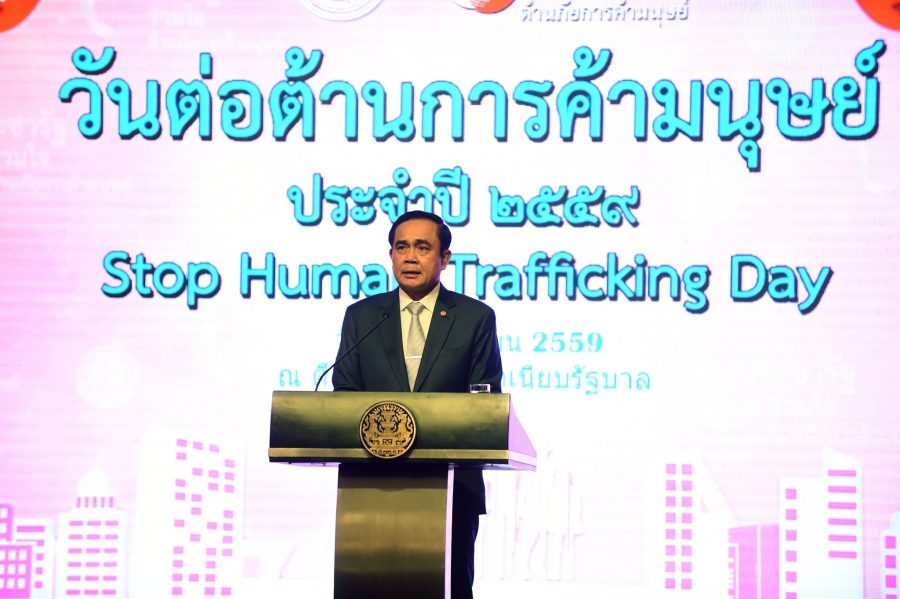
On 6 June Thailand’s Prime Minister General Prayuth Chan-ocha gave a 35-minute speech commemorating the annual Stop Human Trafficking Day in Bangkok. He was also shown on state media donating 3,000 Baht to the Labour Rights Promotion Network (LPN), a non-governmental organisation well-known for rescuing trafficked victims.
While the PM appeared to forget the date and name of the event during the speech, there is no doubt that human trafficking is high on the government’s agenda, despite other pressing issues such as national reconciliation and August’s referendum on the constitution.
Thailand’s renewed interest in human trafficking has come at the height of international criticism. The ruling junta has tremendously intensified its efforts in combating human trafficking but it has only done so in a few sectors, namely seafood industries.
Thailand is the third largest seafood exporter in the world. It makes sense that the government would want to focus its resources on cleaning up the industry. Thailand should be commended for its attempt. This however should not come at the cost of other groups of migrant workers.
Ever since the major exposés by international media like The Guardian and Associated Press, which linked Thailand’s seafood exports to slave labour and big retailers in the United States and Europe, the government has actively worked to improve the image of what Human Rights Watch calls, “Made in Thailand” brands.
Thailand also went through “a moment of shame” at the latest Universal Period Review (UPR), a cyclical review of human rights practice in 193 United Nations member states, and where the international community made sure migrant worker rights were firmly on the agenda.
Since 2014, Thailand has ranked in the lowest Tier 3 in the US Trafficking in Person (TIP) report for not making “significant effort” to combat human trafficking. The report recognises Thailand as “a source, destination, and transit country for men, women, and children subjected to forced labour and sex trafficking.” The subsequent penalty is the cutting of the US non-humanitarian, non-trade assistance with Tier 3 countries.
In 2015, the European Union (EU) also decided to issue a ‘yellow card’, giving Thailand six months to clean up its illegal, unreported and unregulated (IUU) fishing or otherwise face harsh trade sanctions against its seafood exports in the European market. This May, the EU gave Thailand another six months to solve the problem.
Thailand took another blow from the US after President Obama signed a new bill to stop slave-made imports from entering the US earlier this year.
With a heavy storm of international criticism, the ruling junta declared human trafficking a “national agenda” in 2015. The once unfamiliar scene of military men raiding workplaces is now a regular routine.
The government adopted a “Zero Tolerance” policy on human trafficking and increased its expenditure to combat it by 69.33 per cent. Prayuth even mentioned that Section 44 of the Interim Charter, which gives him absolute power, has been put to a “beneficial” use.
Although Thailand pledged to end human trafficking in all sectors, recent legal amendments, ministerial regulations and international treaty ratifications (like the ILO Maritime Labour Convention) demonstrate that Thailand’s effort selectively targets migrant workers in the seafood industries.
Thailand can make its domestic commitment a more genuine one by coming up with a comprehensive policy protecting all migrant workers.
Those employed in other sectors are also doing it tough.
For example, domestic workers, also among the most vulnerable group of migrants, are still excluded from the Labour Protection Act. They work in secluded and private homes without the guarantee of a minimum wage, specified hours of work and overtime pay.
Thailand can further make its commitment a regional one. PM Prayuth has repeatedly called for cooperation among the Association of Southeast Asian Nations (ASEAN) members.
Thailand can ratify the ASEAN convention on human trafficking – after all, as a Thai government official once told me, Thailand pushed for it so hard that “its body is bent” (dtua gohng). It can also help the Philippines and Indonesia push for a legally binding ASEAN instrument on the protection of migrant worker rights which has been on the negotiation table for almost a decade.
A call on ASEAN is the right way forward, as human trafficking can only be dealt with comprehensively when source, destination and transit countries work together.
This year’s TIP report will be released soon. If the PM really wishes to convey his serious commitment, the government must deal with the issue holistically and regionally. It needs to match words with deeds, as urged by the government itself a year ago.
Ruji Auethavornpipat is a PhD candidate in the Department of International Relations, ANU Coral Bell School of Asia Pacific Affairs.


Thailand’s hidden republican tradition | New Mandala

Thailand’s hidden republican tradition | New Mandala
Dr Patrick Jory, 19 JUL, 2016


Despite the intense royalist indoctrination of the Bhumibol era it would be naïve not to imagine that at least some Thais draw inspiration from the country’s long republican tradition.

Thailand is typically understood as a deeply royalist country ruled by a highly revered monarch.
The king’s image is everywhere. The capital, Bangkok, is strewn with monuments to past kings. Countless streets, bridges, dams, universities, schools, army bases, hospitals, etc. are named after royalty. The calendar is full of royal holidays. Thailand has one of the world’s strictest lèse majesté laws which forbids criticism of the king and royal family.
Given all this it may come as a surprise that republicanism is deeply ingrained in Thailand’s political tradition. In fact, Thailand has one of the oldest republican traditions in Asia.
The first proposal to limit the absolute power of the monarch famously came in a petition to the king in 1885. It was drafted not by the European colonial powers but by a group of Thai princes. Though unsuccessful, this was among the first indigenous attempts to limit monarchical power anywhere in Asia.
In 1912, one year after the Chinese revolution ended 2000 years of imperial monarchy, the Thai authorities foiled a plot involving “thousands” to overthrow Siam’s monarchy. It was even said that lots had been drawn to assassinate King Rama VI. The plotters were split between republicans and constitutional monarchists.
As Copeland has shown, the Siamese press at the time mercilessly mocked the monarchy and aristocracy in a way that is unheard of today.
The People’s Party finally succeeded in ending Siam’s absolute monarchy in a bloodless coup on June 24 1932.
What is not widely acknowledged is the influence of republican thinking on the People’s Party, especially the leading intellectual force behind the movement, French-trained lawyer Pridi Phanomyong. It is clearly evident in the famous People’s Party Announcement Number 1, issued after the coup, which Pridi is credited with drafting:
On the question of the head of state, the People’s Party does not wish to seize the throne. It will invite this king to continue in his office as king, but he must be placed under the law of the constitution governing the country. He will not be able to act of his own accord without receiving the approval of the House of Representatives. The People’s Party has informed the king of its wish. We await his reply. If the king refuses the invitation or does not reply by the deadline, selfishly believing that his power has been reduced, then he will be judged to be a traitor to the nation. It will be necessary to govern the country as a republic [prachathipatai]; that is, the head of state will be a commoner appointed by the House of Representatives for a fixed term of office [my italics].
Royalist historiography which dominates the official interpretation of the events of 1932 downplays the role of the People’s Party, instead crediting King Rama VII with granting the gift of “democracy” to the Thai people.
But as the highlighted sentence from the Announcement shows, the term “prachathipatai”, normally translated today as “democracy”, originally conveyed the meaning of “republic”.
In fact, as Nakharin has pointed out, in the original 1932 draft of the Announcement to eliminate any doubt the Thai wordprachathipatai was followed by the English translation, “republic.”
Official dictionaries from this period, both Thai-to-Thai and Thai-to-English, also commonly translate the Thai word prachathipatai as “republic.”
Before 1932, Pridi himself had taught his law students that there were two types of “democracy” (prachathipatai): a country with a president as the head of government, as in France, or a government in which executive authority lay with a committee, as in the Soviet Union.
So Thailand’s democratic history has distinctly republican roots.
For that reason royalists later coined the phrase, “prachathipatai an mi phra maha kasat song pen pramuk” to describe Thailand’s political system. The phrase is officially translated today as “constitutional monarchy”, but its literal translation is “democracy with the sacred, great king as head of state”. Its real purpose is to erase the original republican associations of the wordprachathipatai. Even the word “constitution” has been sacrificed, since placing the king “under” a constitution violates Buddhist spatial norms about the proper place of the king.
Following the failed Boworadet rebellion in 1933 the royalists were routed. King Prajadhipok went into exile and eventually abdicated. Other princes fled Siam or were imprisoned. The heir to the throne escaped to Switzerland. For a decade there was no king in Thailand. Military strongman Field Marshal Phibun Songkhram, who also had republican leanings, ruled as a virtual president. This was the closest Thailand has come to republican rule.
The story of the restoration of the monarchy after World War II has been told before. It culminates with the coups of Field Marshal Sarit Thanarat in 1957 and 1958, following which, with the support of the United States, the monarchy became the figurehead of a virulently anti-communist military dictatorship. As Somsak has pointed out, for the royalists “the threat of communism and the threat of republicanism were one and the same thing”.
From this period monarchy in Thailand became more than just an institution. It legitimised an ideology of submission and servilitythat lives on today.
Under this royalist-military regime the erasure of Thailand’s republican tradition from official history was completed.
Following the routing of the Communist Party of Thailand and the end of the Cold War the last traces of republican political thinking were expunged. As a result a generation of Thais have been estranged from their country’s republican tradition.
The political conflict that erupted in 2005 between Thaksin and the palace has now entered its eleventh year with no resolution in sight. Royalists repeatedly accuse the Thaksin forces of seeking to lom jao – “overthrow the monarchy”. Despite this, or perhaps because of it, pro-Thaksin parties have repeatedly won free elections.
The mainstream pro-Thaksin forces have consistently denied they have a republican agenda. For obvious reasons surveying republican sympathies in Thailand today is impossible. Yet despite the intense royalist indoctrination of the Bhumibol era it would surely be naïve not to imagine that at least some of them may draw inspiration from Thailand’s long republican tradition.
Patrick Jory’s new book, “Thailand’s Theory of Monarchy: The Vessantara Jataka and the Idea of the Perfect Man”, has just been published by SUNY Press. For details, including how to order the book, see this link: http://www.sunypress.edu/p-6222-thailands-theory-of-monarchy.aspx


Thai youth activism rekindling hope | New Mandala

Thai youth activism rekindling hope | New Mandala
Kriangsak Teerakowitkajorn, 11 JUL, 2016


Are new protest movements driven by young people enough to inspire citizens and save the country’s ever-decreasing democratic hopes?
Once upon a time, there was a land of smiles. Now, with the bleak economy, and the rising household debts of the working class, some are calling Thailand ‘the sick man of Southeast Asia.’
The political deadlock has reached the point where ordinary Thais have almost forgotten how it started in the first place. Everyday it seems, the junta introduces new, more worrisome, problems— takethe Single Gateway for instance.
In terms of civil and political freedoms, Thailand’s record is abominable. The junta has silenced liberal and progressive critics – by both coercion and repression. Some of the most outspoken voices have either gone underground or into exile. Those who do not have the privilege to flee join the growing number of political prisoners now filling up prisons.
In the face of these concerns, the Thai public is being told to ‘shut up and consume,’ and leave their future in the hands of a paternalist oligarchy. Their proposed charter gives us a frightening glimpse into the society that they wish to bring about. For example, proposed cuts to free high school—replaced by pre-elementary education—redistributes state welfare to the needs of the urban middle class, at the expense of working families.
Without the freedom of speech to debate the charter, hope seems to be wanting, desperately, in the land of ‘free people.’
Over the last few months I have been living in Myanmar. There, concerned NGO and activist friends often ask me about the political situation in Thailand: am I optimistic about the political future?
Given the downward spiral we have witnessed since the military coup in May 2014, I am always tempted to offer a pessimistic outlook. Recently, however, I am inclined to give a different kind of response, one informed by new sources of inspiration.
The Thai political landscape has changed so rapidly and profoundly since Thailand’s latest coup – not to mention the previous coup in 2006 – that the counter-movement it has created is nascent and still taking form. Yet, the emergent movement – or rather, movements – of young activists has already become a source of strength for ordinary people.
I am talking about the arrival of courageous, well-organised and creative student activism led by Dao Din, Liberal League of Thammasat for Democracy (LLTD), Liberal Assembly of Chiang Mai University for Democracy (LACMUD), and the New Democracy Movement (NDM).
In my conversations with older generations of Thai activists, people often raise the concern that activists struggle to build on disparate protest events to create an organised sustained movement. This challenge is associated with the fact that, in past years, protests led by Bangkok-based activists frequently resulted in one unintended consequence: activists are singled out and turned into high profile martyrs, leaving the campaign disrupted and momentum lost.
Over the past two years, however, Thai student activists have increasingly shown that they are not only better coordinated, but also more strategic in their response to the limitations of the legal landscape.
Looking back to the days of the spontaneous ‘Hunger Games’ salute, recent actions are more effective and better conceived; especially in the way they allow broader participation with low personal risk. For instance, the series of ‘Toys, Dolls and Balloons’ protests in Bangkok, Chiang Mai, Khon Kaen, Pattani and Chiang Rai, allow people to use objects to express otherwise outlawed opinions on the country’s proposed new charter.
It would be misleading to talk about the movements without acknowledging the critical supporting role of human rights lawyers, progressive scholars and journalists, and other veteran activists. More importantly, each group in the student movement has its own strengths, approaches, and area of priorities.
For instance, the urban-based groups such as NDM are shrewd in their ability to frame campaigns around the tastes and interests of urban Thais, whereas Dao Din, recently organising under the umbrella of the New E-Saan Movement, is committed to grassroots community organising on issues that resonate in the Northeast.
While urban Thais and Northeasterners share the goal of returning democracy to the country, there remains a fundamental question in terms of how to negotiate different priorities on everything from free education to development projects.
What I have learned from the movement for democracy in Myanmar is that movements are at their most powerful when diverse groups with different priorities manage to cultivate trust and a shared collective vision. With Thai youth activists breathing new life into political activism, hope has been rekindled for the most cynical among us.
The challenge that awaits us – for both the inspired and cynical – is how we can now collectively build on the strength and diversity of the democracy movement to bring into being a shared vision inclusive of the needs and desires of the whole country.
Kriangsak Teerakowitkajorn is a Thai political economist, and trainer for social change. He is completing a PhD at the Department of Geography, Syracuse University, researching the geography of labour activism in the Thailand’s industrial estates.


Tuesday, July 5, 2016

Red and Yellow in Germany | New Mandala

Red and Yellow in Germany | New Mandala
Nick Nostitz, 04 JUL, 2016

On 18 June, I was invited to talk at a symposium at the University of Bonn in Germany, organised in conjunction with Stiftung Asienhaus and several Red Shirt groups in Europe.

I spoke at a workshop on the Red Shirts after the coup, and the final podium discussion on the future of democracy in Thailand. There were workshops on more sensitive topics as well, which I did not participate in.
After the opening talks in a large and fully occupied lecture hall, Ajarn Pitch Pongsawat and Nopporn Khunikha talked about the new constitution and Ajarn Pavin Chachavalpongpun spoke on the monarchy. Other workshops covered a range of topics, including the constitution and the referendum, led by Professor Wolfram Schaffar, Dr Pitch Pongsawat and Dr Vichien Tansirikongkhont; the monarchy and lese majeste, led by exiles Junya Jimprasert and Aum Neko, Dr Serhat Uenaldi and Andrew MacGregor Marshall; and human rights violations under the military regime, led by Kunthika Nutcharus and Kheetanat Wannaboworn.
A workshop on the Red Shirt movement was led by exiled Red Shirt leader Visa Kanthap, local Red Shirt activist Bangon Schwarz, Dr Claudio Sopranzetti, and myself. The final workshop examined exiled activists, the European Union and strategies for democracy, and was led by Din Buadaeng, exiled Red Shirt leader Jaran Ditapichai and Kwanjai Chularat.
In my workshop Bangon Schwarz talked about why she as an ordinary Thai became interested in politics. Visa Khantap talked about his long political struggle since the 1970s and the split of former friends into the Red and Yellow camps. I talked mostly about why the Red Shirts have not actively opposed the military coup, reasoning that the majority of Red Shirts are not revolutionaries, but normal citizens and a reflection of the Thai population, who want to express their political views via elections. In the present conditions active opposition would mean imprisoned and dead people, and that the UDD and most other Red Shirt groups had to design their strategies according to this.
I also mentioned that the demand that the Red Shirts should separate from Thaksin would be quite unrealistic, given that the majority of the Red Shirts were people who benefited under the populist schemes introduced by his government. In fact, such a demand would be an infringement on the people’s democratic right to support their politician of choice, and would therefore alienate these sectors of the population similar to what took place when the PAD began protesting against Thaksin in 2005/2006.
When it was asked if more aggressive strategies should be followed I said that this would be quite counterproductive as a civil war would not be in anyone’s interest, and that in the end both Red Shirts and Yellow Shirts are still Thais and have to find ways to continue to live with each other.
In our room three PDRC supporters took part as well. There were some frictions, naturally. Some of the Red Shirts in the room objected that the PDRC supporters filmed the talks, but as the event was live-streamed, and several of the participants filmed as well, I said that the PDRC supporters should also be allowed to film. One Danish PDRC supporter said that the Yingluck government came from vote buying and was therefore not democratic.
I answered that this is an unproven allegation, and referred to the ANFREL election observers who concluded that in general, the 2011 elections went well. I also mentioned Pasuk Phongpaichit and Chris Baker’s article, published on 6 December 2013, in The Bangkok Post, “Vote-buying claims nothing but dangerous nonsense”. When moderator Oliver Pye asked to get back to the main topic of the Red Shirt movement the three PDRC supporters walked out of the room.
During a break after the workshops, while participants had cake and coffee, about 15 PDRC supporters, who mostly came from Denmark, gathered near the university’s gate for a counter protest. Organisers of the seminar and the later Red Shirt protest march called the police, fearing that some incident might happen.
During the symposium authorities had watched over the PDRC supporters, to protect them against possible attacks from over-emotional Red Shirts, which did not happen. While not happy about the PDRC, the Red Shirts treated them respectfully. Police then arrived, and politely asked the PDRC supporters to gather at a nearby place where they have announced their protest, and the PDRC supporters soon left to their protest venue.
The following day, Naewna newspaper published coverage on thePDRC protest and a scathing report on the seminar.
The final podium discussion took again place in the lecture hall, with Junya Yimprasert, Jaran Ditapichai, Wolfram Schaffar and me on the podium, moderated by Oliver Pye. An interesting friendly side debate took place on the podium between Wolfram Schaffar, who framed the conflict in Thailand in context with the worldwide developments on liberal democracy under attack by rich elites and problems over distribution of wealth, and me, who looked at the Red-Yellow conflict as primarily an identity crises, a transformation conflict and a conflict over participation that is part of the development towards democracy in Thailand.
After, a protest march through Bonn’s inner city was organised. The lecturers flown in from Thailand opted not to take part, as to not violate their university rules. Naturally, I also did not participate, but used the opportunity to take pictures. The day ended in a picnic and party in the villa of one of the organisers in a suburb of Bonn.
Nick Nostitz is a photo-journalist and long-time contributor to New Mandala. Following are some of the images he captured at the symposium.


Andrew MacGregor Marshall prepares for his workshop.